After ALMM for modules, the next major shift is ALCM — the Approved List of Cell Manufacturers, formally ALMM List-2 for solar cells. For any business planning a rooftop or ground-mounted project, this directly affects your project cost, timeline, and module choices.
India’s solar story has always run on two engines: rapid project deployment and a national push to manufacture more at home. For years, both moved at roughly the same speed. In 2026, that balance is being tested.
After ALMM for modules, the next major shift is ALCM — the Approved List of Cell Manufacturers, formally ALMM List-2 for solar cells. For any business planning a rooftop or ground-mounted project, this isn’t just a manufacturing policy buried in a government order. It can directly affect your project cost, timeline, module choices, and how you pick your EPC partner.
At Avco Energy, we work on C&I rooftop solar India projects every day. So we’ll explain ALCM the way it plays out on the ground.
What is ALCM?
ALCM is the Approved List of Cell Manufacturers — the cell-level counterpart to the ALMM framework you know for modules.
- ALMM List-1 = approved solar modules (panels). Mandatory for most projects since 2021.
- ALMM List-2 / ALCM = approved solar cells (the part inside the panel that converts sunlight to power).
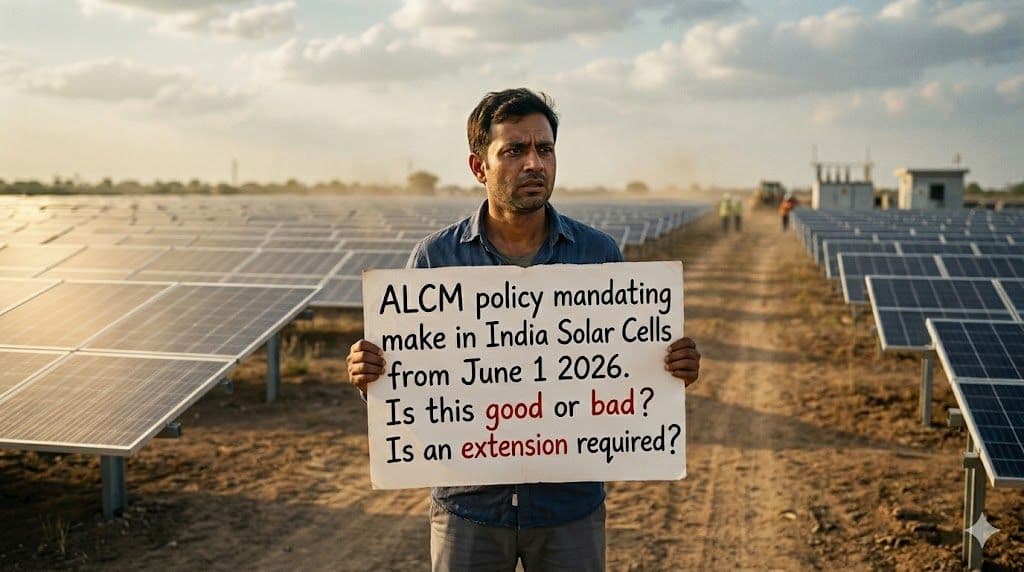
From 1 June 2026, modules in most projects must use cells from an approved domestic manufacturer. It’s no longer enough for the panel to be approved — the cell inside must be too.
| Feature |
ALMM List-1 |
ALMM List-2 / ALCM |
| Covers |
Solar modules (panels) |
Solar cells (inside panels) |
| In effect |
April 2021 |
1 June 2026 |
| Purpose |
Quality + domestic modules |
Backward integration into cells |
Why is India Implementing ALCM?
The intent is strategically sound. India has built a large module base — over 190 GW of listed capacity — but most of it still relies on imported cells, largely from China. ALCM pushes the supply chain one step upstream to build genuine solar cell manufacturing India capacity, cut import dependence, and strengthen energy security. This is the right long-term direction. The real debate is about how fast the ecosystem can move.
The EPC Perspective — Where the Challenge Begins
This is the part most policy articles skip. An EPC doesn’t just sell panels — we own delivery, timelines, performance, warranties, and procurement. When one input gets restricted, it ripples through all of it.
The approved cell pool today sits at roughly 30 GW across about 13 manufacturers (per the latest publicly available ALMM List-2), against a module base several times larger. That mismatch is the source of the near-term concern.
The technology gap makes it harder. 🔑 Much of India’s existing approved cell capacity is older Mono PERC, while developers and EPCs are increasingly demanding TOPCon — the technology that now defines a bankable, future-proof project. So the shortage isn’t just about quantity of domestic cells; it’s about whether enough TOPCon cells are genuinely available and stable. New TOPCon lines need months to stabilise after starting up, which is why this transition is tighter than the headline capacity numbers suggest.
The Cost Impact — In Plain Numbers
Here’s what this means for your project budget. The price gap between compliant (DCR) and non-DCR modules is significant:
| Metric |
Non-DCR |
DCR (List-2 compliant) |
Difference |
| Price (per watt) |
~₹14–15 |
~₹24–25 |
~₹9–10/W |
| Cost per 1 MWp (modules) |
~₹1.4–1.5 crore |
~₹2.4–2.5 crore |
~₹80–90 lakh more per MWp |
For a factory or commercial buyer, that ₹80–90 lakh increase in module cost alone is a real number that changes payback math — which is exactly why when and how you procure now matters as much as the system design.
What C&I Customers Should Do
The economics of rooftop solar for business remain strong. But chasing the cheapest quote and assuming supply will sort itself out is now the biggest risk. A few clear priorities:
- ✅ Plan early and lock technical specifications before prices and availability shift.
- ✅ Work with credible EPCs who have real vendor relationships and delivery certainty.
- ✅ Don’t chase only the lowest quote — check module make, warranty, and ALMM/ALCM compliance.
- ✅ Evaluate lifetime value, not just lowest capex, over a 25-year asset.
Impact on Solar EPC Companies
For solar EPC India players, the pressure is real and immediate:
- Fewer projects in the short term, as the sudden cost increase pushes some buyers to pause or rethink.
- C&I deployment slows down — and this lands on an industry already feeling the effects of the Iran conflict on costs and sentiment.
- Procurement planning becomes a true differentiator. EPCs with secured TOPCon cell supply and strong vendor ties will deliver; others will struggle.
- Working capital cycles tighten as DCR module costs rise.
Impact on Module Manufacturers
The effect on domestic solar manufacturing India is uneven. Integrated manufacturers (cells + modules) are well positioned. Non-integrated assemblers relying on imported cells face the hardest sourcing challenge, and OEM/tolling models come under pressure. Bankability and supply reliability now matter more than headline price.
Will ALCM Increase Project Costs?
In the short term, yes — the DCR premium and limited compliant cell supply put real upward pressure on solar module prices India. In the medium to long term, as domestic cell capacity scales, supply security improves and import dependence falls. The outcome depends on how smoothly the transition is managed and how fast operational TOPCon capacity ramps.
Why a Pragmatic Transition Matters
This week, the Rajasthan Solar Association urged MNRE to adopt a phased, calibrated rollout rather than a sudden switch. The concern isn’t opposition to domestic manufacturing — it’s implementation readiness and avoiding disruption to live projects.
A well-planned transition can support both manufacturing and deployment. A rushed one creates avoidable friction for EPCs, customers, and manufacturers alike.
Avco Energy’s View
We believe India’s domestic manufacturing push is the right long-term direction. But for the policy to succeed, implementation must balance manufacturing ambition with execution reality. As your EPC partner, our job is to deliver compliant module selection, reliable vendor evaluation, honest timelines, transparent costs, and long-term service support.
Conclusion
ALCM is not just a policy update — it’s a structural shift in India’s solar supply chain. Solar remains a strong investment. What’s changed is that planning, compliance, and EPC partner selection now matter more than ever.