What happened
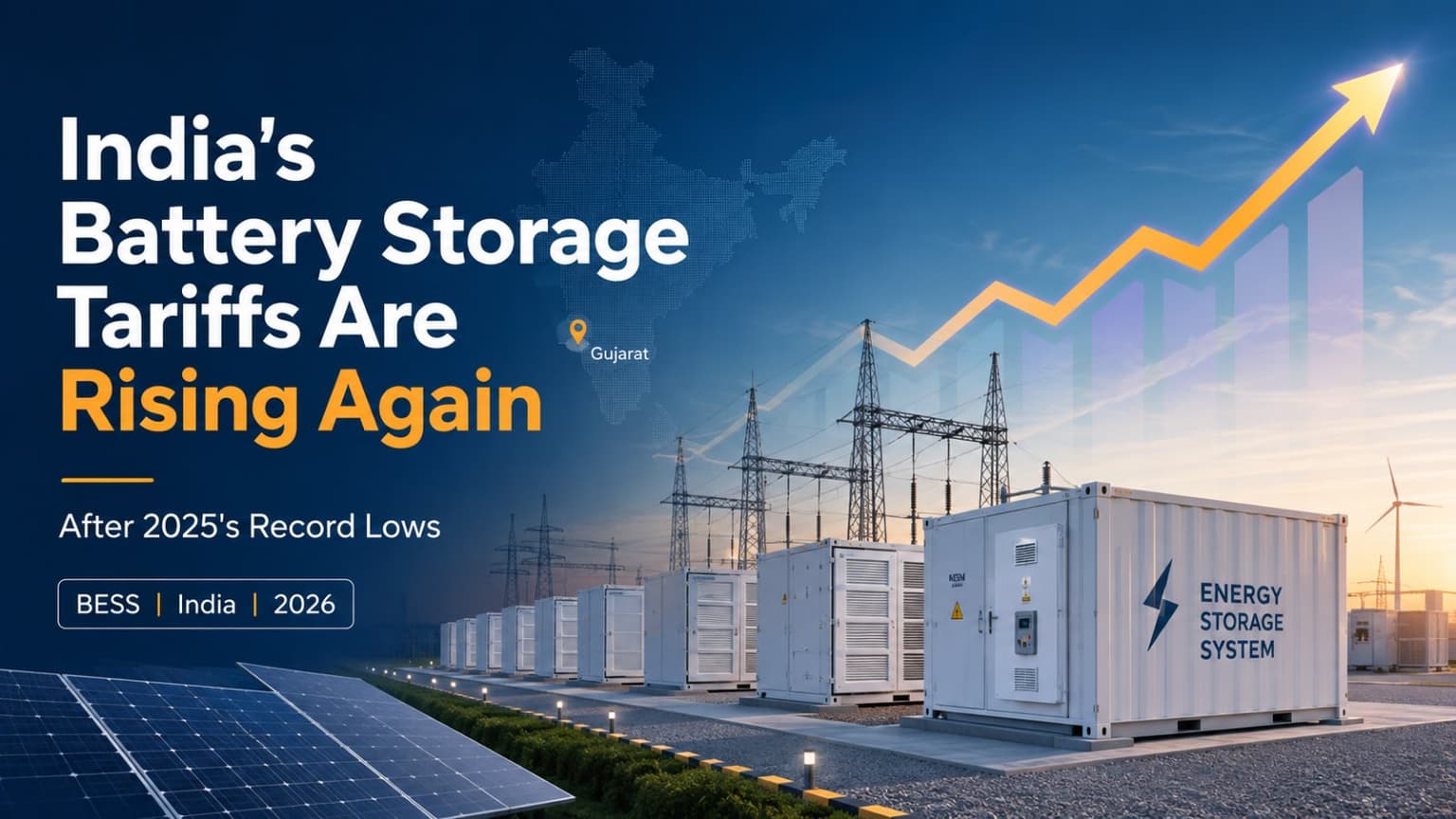
Standalone BESS tariffs (the price DISCOMs pay a developer to build and operate battery storage, agreed through tariff-based competitive bidding, independent of any accompanying solar or wind project) fell roughly 33% during 2025, from about Rs 2.21 lakh per MW per month in early 2025 to Rs 1.48 lakh per MW per month by year-end, according to a review by the India Energy Storage Alliance (IESA). India awarded 10.4 GW of standalone BESS capacity across 18 auctions that year, per a joint report from JMK Research and the Institute for Energy Economics and Financial Analysis (IEEFA).
That same IEEFA-JMK report, published in May 2026, delivered the warning behind this year's reversal: roughly 75% of the 2-hour standalone capacity allocated in 2025 is now financially at-risk, because the tariffs bid then no longer cover the cost of the batteries the projects need. The market has since begun to correct. The Gujarat Electricity Regulatory Commission (GERC) approved tariffs of Rs 185,390 to Rs 189,000 per MW per month for a 1.665 GW/3.33 GWh tranche in a March 2026 order - the first significant move off the sub-Rs 1.5-lakh floor. By August, Gujarat Urja Vikas Nigam (GUVNL) discovered Rs 231,989 per MW per month in its Phase IX tender (450 MW/900 MWh, won by NLC India Renewables and Sun Drops Energia). On the same day this article was researched, GUVNL opened bidding for a further 1,000 MW/4,000 MWh of standalone storage (Phase X) - the market shows no sign of slowing, even as prices reset upward.
Why it matters
Tariffs this low were never going to last, and their unwinding has real consequences beyond the auctions themselves. Standalone BESS tariffs function as a public benchmark: developers, lenders and buyers across the wider storage market - including C&I projects that pair storage with solar - use recent auction results to sanity-check their own cost assumptions. A benchmark that quietly stopped reflecting reality for the better part of a year has now been reset, and anyone who built a financial model on the December 2025 number needs to revisit it.
How it works
Two cost pressures explain most of the increase.
Battery cell costs are rising. China's Ministry of Finance is phasing out VAT export rebates on batteries - cutting them from 9% to 6% from 1 April 2026, and to zero by 1 January 2027. Because China supplies the large majority of the lithium-ion cells used in Indian BESS projects, the change lifts landed cell costs for Indian developers directly, and lithium carbonate prices moved sharply higher when the policy was first signalled.
Compliance costs are rising too. In late December 2025, the Ministry of Power directed that BESS projects supported by Viability Gap Funding (VGF - central government capital support that narrows the gap between a project's real cost and a commercially bearable tariff) must source a minimum of 20% of project cost domestically, including energy management system (EMS) software. That is a cost most 2025-vintage bids were not built to absorb.
Who is affected
DISCOMs and state utilities procuring standalone storage now face higher discovered tariffs than a year ago, which flows into the cost of grid balancing and, eventually, retail tariffs.
Developers holding 2025-vintage awards are the group IEEFA and JMK Research flag as most exposed - contracted at tariffs that may no longer cover current battery costs, with financing and construction at risk if supply agreements cannot be renegotiated.
C&I buyers evaluating their own storage - whether a standalone BESS for demand-charge management, or storage bundled into an open access or group captive solar project - are indirectly affected. The DISCOM tenders are not their price, but they are the closest live signal of what battery-backed capacity actually costs to build in India right now.
Projects seeking VGF support must now factor in the local-content compliance requirement when structuring their bid, in addition to the underlying hardware cost.
What it means commercially
A C&I buyer who benchmarked a storage-backed proposal against the Rs 1.48-lakh December 2025 low is benchmarking against an outlier the market itself has since disowned. The more representative reference point today sits in the Rs 1.85-2.32 lakh range established by GERC's and GUVNL's 2026 orders - a band roughly a quarter to over half above the 2025 low, depending on which point in that range is used. That does not mean storage has become uneconomic; battery costs and tariffs have both fallen substantially over the past several years. It means the specific December 2025 figure was not a durable price, and should not be the number a 2026 or 2027 proposal is measured against.
For RESCO/OPEX storage arrangements in particular - where a developer, not the customer, carries the capital cost and the customer pays for the service - the same forces apply to the developer's own economics. A quote built on stale battery-cost assumptions, or on a supply agreement not locked at the price it assumed, carries execution risk the customer will ultimately feel through delay or renegotiation.
What Indian businesses should consider
Re-benchmark any storage cost assumption against 2026 discovered tariffs (Rs 1.85-2.32 lakh/MW/month), not the December 2025 low.
For RESCO/OPEX storage proposals, ask whether the developer's battery supply agreement is fixed at the assumed cost, or floating with post-April-2026 landed cell prices.
For any project structured to draw on Viability Gap Funding, confirm the 20% domestic-content requirement is already priced into the quote, not treated as a later change order.
Track SERC tariff orders (GERC and equivalents in other states) through the rest of 2026 as the live reference point - the number is still moving.
Avco Energy's View
In our view, this repricing is a correction, not a crisis. The tariffs discovered through much of 2025 were the product of intense bidder competition for volume, at a moment when battery costs happened to be near a cyclical low; treating that combination as a permanent price was always going to be tested by the next cost shock, and China's export-rebate phase-out supplied it. What has changed is that regulators are now approving tariffs that more plausibly cover the cost of the underlying hardware, which is a healthier basis for a market this early in its build-out to grow from.
For C&I buyers, the practical takeaway is to treat any battery-storage quote - whether for a standalone asset or bundled into a larger renewable project - as something to underwrite against current cell costs and current compliance requirements, not against a tariff chart that peaked a year ago. A developer who cannot explain how their price survives both should be asked to.